Posted on June 12, 2025
Every day until 2030, 10,000 Baby Boomers will turn 65. Not to mention that seven out of ten people will require long-term care in their lifetime. Fortunately, there are several tax-advantaged ways to help take the sting out of the costs of long-term care.
Buying long-term care insurance is one way to ease the financial burden, especially when you consider that assisted living community costs increased by 10% to an annual national median of $70,800 per year, according to the latest study by Genworth, a long-term care insurer. Private room nursing home costs are a whopping $127,750.
Breaking it down to monthly costs: For a semi-private room at a nursing home, you will pay an average of $9,277, and for a private room, $10,646. Community and assisted living costs are lower but still substantial. The monthly cost of adult day health care is $2,167, while care in an assisted living facility averages $5,900. Long-term care insurance is expensive.
Keep in mind that because long-term care isn’t considered medical care, regular health insurance won’t cover these costs. And, because you’ll first have to use up your assets, Medicaid, the government program for people with low income, may not cover these costs either.
Here are four tax-friendly ways to cover the costs of your long-term care insurance premiums.
1. Tax-free withdrawals from an HSA
An HSA is a tax-advantaged account that can be used to pay for qualified medical expenses, like copays, prescriptions, eyeglasses, dental care, X-rays, and more. Your contributions reduce your taxable income, and the money isn’t taxed while it’s in the account. Plus, as long as you use your HSA funds for qualified medical expenses, you won’t owe taxes when you take money out of the account.
As a bonus, if you have a health savings account, you can withdraw money tax-free to pay a portion of eligible long-term-care insurance premiums. The amount you can withdraw is based on your age.
According to the American Association for Long-Term Care Insurance and the IRS, the 2025 tax-deductible limits for long-term care insurance premiums, by age, which also apply to HSA withdrawals, are:
- Age 40 or younger: $480 per year
- Ages 41 to 50: $900 per year
- Ages 51 to 60: $1,800 per year
- Ages 61 to 70: $4,820 per year
- Age 71 and older: $6,020 per year
See IRS Publication 969, Health Savings Accounts and Other Tax-Favored Health Plans, for more information.
2. Deduct long-term-care premiums as a medical expense
A portion of your long-term-care premiums can qualify as a tax-deductible medical expense; the same age-based limits apply to these deductions as to health savings account withdrawals. You can’t double dip and deduct the expenses if you took a tax-free HSA withdrawal to pay the same costs. Medical expenses are deductible to the extent they exceed 7.5% of your adjusted gross income. Most traditional long-term-care policies issued in the past several years are eligible.
See IRS Publication 502, Medical and Dental Expenses, for more information about the requirements.
3. Make a tax-free transfer from an annuity
You can transfer money tax-free from an annuity to cover premiums for a traditional long-term-care policy or to pay for another annuity that also provides long-term-care benefits. The transfer (called a 1035 exchange) must be made directly from the annuity to pay the premiums. If you withdraw the money from the annuity rather than making the tax-free transfer, you have to pay income taxes on the gains, which are taxed first, before you recover your principal.
Read: How To Pay For long-Term Care. You can also reach out to your long-term-care insurer for help making the transfer.
2. Deduct long-term-care premiums as a medical expense
A portion of your long-term-care premiums can qualify as a tax-deductible medical expense; the same age-based limits apply to these deductions as to health savings account withdrawals. You can’t double dip and deduct the expenses if you took a tax-free HSA withdrawal to pay the same costs. Medical expenses are deductible to the extent they exceed 7.5% of your adjusted gross income. Most traditional long-term-care policies issued in the past several years are eligible.
See IRS Publication 502, Medical and Dental Expenses, for more information about the requirements.
3. Make a tax-free transfer from an annuity
You can transfer money tax-free from an annuity to cover premiums for a traditional long-term-care policy or to pay for another annuity that also provides long-term-care benefits. The transfer (called a 1035 exchange) must be made directly from the annuity to pay the premiums. If you withdraw the money from the annuity rather than making the tax-free transfer, you have to pay income taxes on the gains, which are taxed first, before you recover your principal.
Read: How To Pay For long-Term Care. You can also reach out to your long-term-care insurer for help making the transfer.
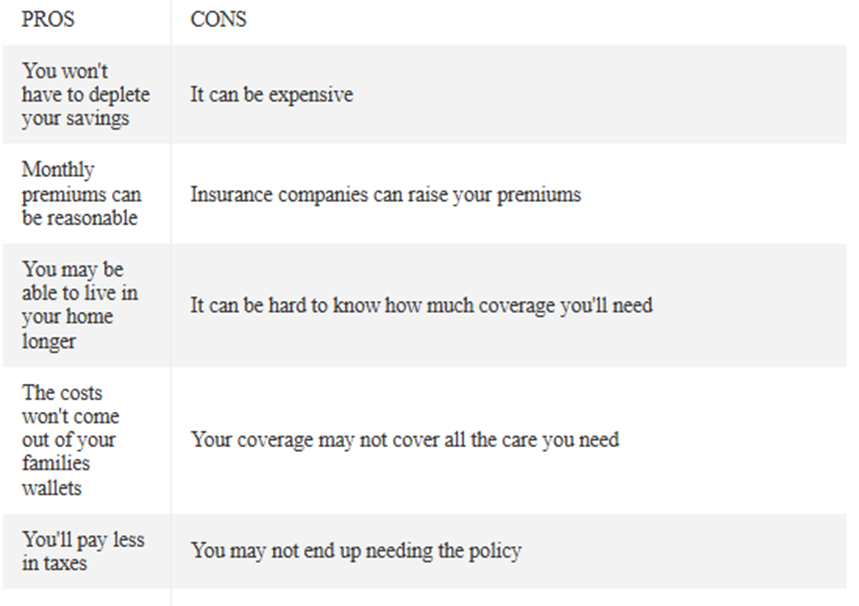
Pros and Cons of long-term care insurance
Final Word
You can get long-term care at home, in the community, in an assisted living facility or in a nursing home. It’s important to start planning for long-term care now to maintain your independence later and make sure you get the care you may need, in the best setting you want.
Medicare, Medicare Supplement Insurance (Medigap) and most other health insurance won’t pay for long-term care. You might qualify for long-term care through Medicaid, or you can choose to buy private long-term care insurance. Remember, no matter how carefully you plan for retirement, if you don’t have long-term-care insurance, a catastrophic illness could wipe out your savings.
By Donna LeValley, Kimberly Lankford
Recent Comments